
Quick Answer: SSB Day 1 is when the assessment begins. You face two psychology tests (TAT, WAT), document checks, group discussions, and the initial Officer Like Qualities (OLQs) evaluation. This day determines whether you progress to days 2–5 (GTO, lecturette, PI) or go home. Understanding what to expect and how officers assess OLQs during Day 1 is critical — because your first impression matters, and it lasts all 5 days.
The First Day Is Everything
You’ve cleared the written exam. Your name is on the SSB call letter. You’ve traveled to the recruiting centre. And now — on Day 1 morning — you walk into the SSB building with 30 other candidates.
Every officer in that building is already observing you. How you walk. How you sit. How you greet. How you respond to the first question. This is Day 1 of a 5-day process, and by the end of this day, the board has already formed an initial impression that will shape the remaining four days.
This is critical. This guide walks you through every minute of SSB Day 1 — what happens, what officers are evaluating, and how you can ace it.
8:00 AM: You Enter the SSB Centre
The bus drops your batch of 30 candidates at the gate. You’re nervous. You’ve heard stories about SSB. Now you’re living it.
First Observation Point: Officers are already watching. How you get off the bus. How you greet the staff. How you stand in line. Candidates who are alert, greeting staff, smiling — they stand out. Candidates who look nervous, blank, or unsure — officers note that too.
8:15 AM – 9:00 AM: Initial Briefing & Document Verification
Group of 30 cadidates sits in an auditorium. The Conducting Officer (CO) welcomes you. Sets the tone. Explains the 5-day process. Rules (no mobile phones, no discussing questions with other candidates, no negative talk about the process).
Then document verification begins — officers go through your certificates, marksheets, admit card, signature verification. This is tedious but necessary.
OLQ Assessment Happening Now: While sitting idle, officers observe — Are you fidgeting? Are you alert? Are you scanning the room to see what others are doing (a sign of comparison anxiety)? Are you mentally prepared?
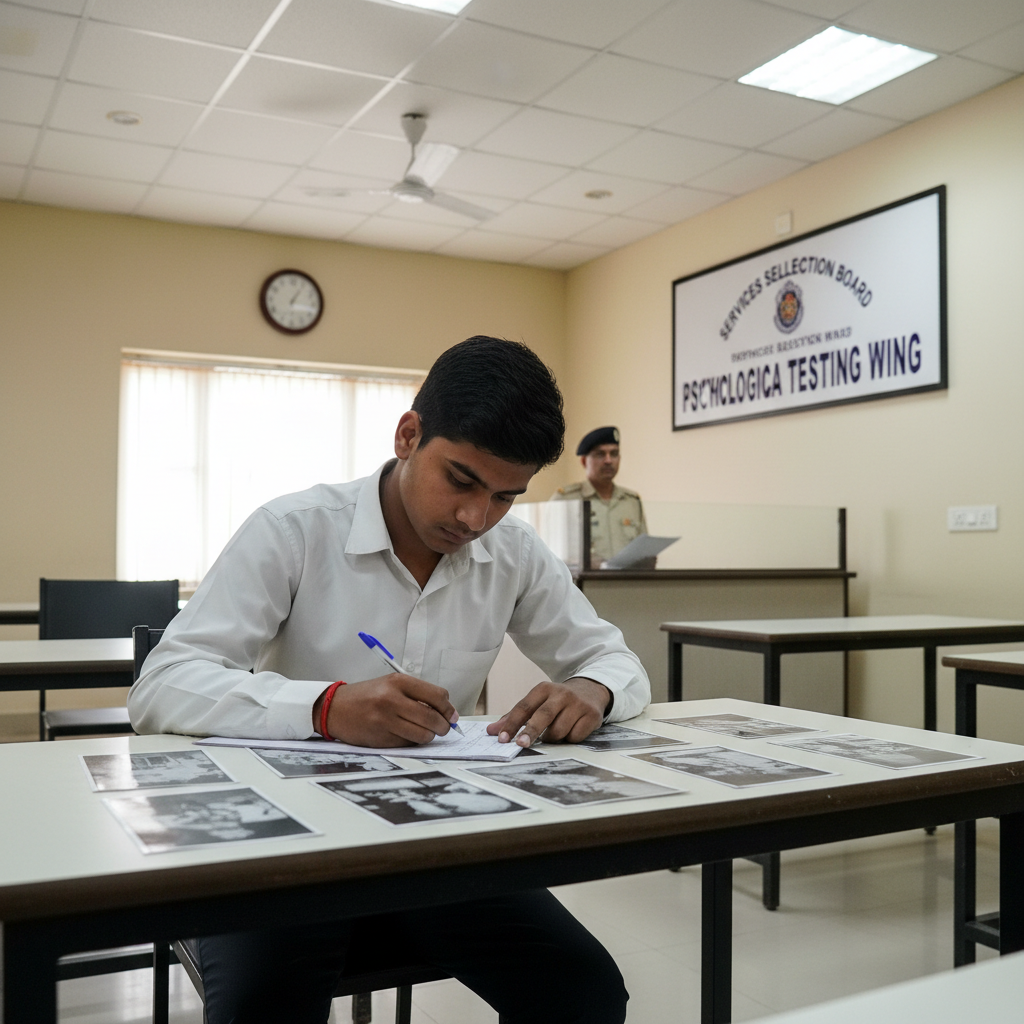
9:00 AM – 10:00 AM: Thematic Apperception Test (TAT)
This is the first formal psychology test. You enter a room with an assessor. You see 11 picture cards. For each card, you have 30 seconds to observe and 4 minutes to write a story.
What Are Officers Evaluating in TAT?
Not the literary quality of your story. Not whether your handwriting is neat. Not whether your story has a happy ending.
Officers are assessing:
- Perception: What details do you notice in the picture? Do you miss obvious elements? Do you over-interpret?
- Imagination: Can you create a story? Is it realistic or too fantastical? Does it show leadership thinking?
- Values: What characters do you include? Soldiers? Officers? Villagers? What problems do you highlight — national security, family issues, social problems? Officers read your value system through your story.
- Goal Orientation: Do your story protagonists have clear goals? Do they overcome obstacles? Do they succeed or give up? This reveals your drive.
- Officer-Like Qualities in story characters: Do you create characters who are courageous, decisive, responsible, calm under pressure? Or characters who are reactive, fearful, indecisive?
- Speed & Confidence: Can you write a complete story in 4 minutes? Do you cross out? Do you hesitate? Officers see your thought speed and decisiveness.
10 Tips for TAT Success
| # | Tip | Why It Matters |
|---|---|---|
| 1 | Include military / leadership themes in 7 of 11 stories | Shows defence aspirant mindset |
| 2 | Create protagonists who are responsible, decisive, courageous | Projects Officer-Like Qualities onto your characters |
| 3 | Make your protagonist succeed by overcoming obstacles | Shows goal orientation and resilience |
| 4 | Include social responsibility or national service angle | Shows values alignment with military service |
| 5 | Write confidently without crossing out or erasing | Shows decisiveness and clarity of thought |
| 6 | Use vivid verbs — “led”, “guided”, “motivated”, “commanded” | Active language reflects active thinking |
| 7 | Avoid sad, depressing, or failure-oriented endings | Negativity can bias assessor perception |
| 8 | Keep stories realistic, not fantastical | Anchors imagination in real-world thinking |
| 9 | Reference family, duty, sacrifice subtly | Shows understanding of military values |
| 10 | Complete all 11 stories within time — no blanks | Shows focus and discipline |
10:00 AM – 11:00 AM: Word Association Test (WAT)
You’re given 60 words. For each word, you have 15 seconds to write the first meaningful response that comes to mind.
Example words: Discipline, Failure, Fear, Mother, Soldier, Responsibility, Duty, Success, Sacrifice, etc.
What Are Officers Evaluating in WAT?
- Word Association Speed: Quick, confident responses = good. Delayed, hesitating responses = concerning.
- Values Alignment: When you see “Sacrifice”, do you write “for nation” or “waste”? Officers see your values instantly.
- Officer-Like Qualities: Words like “Discipline” should get positive associations (“essential for leadership”). “Fear” should get “overcome” or “face”. Your associations reveal your mindset.
- Maturity: Can you think beyond surface-level responses? “Mother” → “love and support” is basic. “Mother” → “sacrificed everything for my education” shows depth.
- Reaction to Negative Words: When you see “Failure”, do you write something negative like “bad”? Or do you turn it positive — “learning opportunity”? This reveals growth mindset.
10 Tips for WAT Success
- ✅ Speed: Write immediately after reading — no thinking pauses. 15 seconds per word is strict.
- ✅ Positive associations: Even for negative words, find a constructive angle. “Fear” → “motivates caution” not “paralyzes”.
- ✅ Officer values: “Duty”, “Discipline”, “Honour” → write responses that honour these values. “Duty is sacred” not “boring”.
- ✅ Maturity: Simple words need thoughtful associations. “Friend” → “loyal companion in struggle” not just “good person”.
- ✅ Consistency: All 60 responses should paint a picture of someone mature, positive, values-driven, and resilient.
- ✅ Handwriting matters:** Make it legible. Officers must read your response in seconds.
- ✅ Grammar is not critical: “Fear overcome” is fine instead of “Fear can be overcome”. Speed > grammar here.
- ✅ Avoid clichés: Everyone writes “Mother is love”. Can you write something more thoughtful?
- ✅ No blanks: Every word gets a response. Leaving a word blank signals anxiety.
- ✅ Nation-focused: 5–7 responses should subtly reflect nation, service, duty. It reminds officers you’re a defence aspirant.
11:00 AM – 12:00 PM: Group Discussion (GD) — Screening Round
30 candidates are divided into groups of 10. A topic is given: “Should India increase its defence spending?” or “Importance of discipline in military” or “How to solve farmer distress?”
You have 10 minutes to discuss. Officers sit around the circle, observing. They are NOT judging who has the best idea. They are judging how you express ideas, how you listen, how you interact, how you lead or support.
What Are Officers Evaluating in GD?
| OLQ | What Officers Look For |
|---|---|
| Communication | Can you speak clearly? Confidently? Without rambling? Do you think before you speak? |
| Leadership | Do you naturally take charge of the discussion or pull back? Do you guide others without dominating? |
| Listening | Do you listen to others’ points or just wait for your turn? Do you respond to what others say or repeat yourself? |
| Teamwork | Do you complement others’ ideas or shut them down? Do you encourage quiet members to speak? |
| Knowledge | Do you have substantive points or just opinions? Can you back your idea with logic or examples? |
| Open-Mindedness | Do you dismiss opposing views or engage with them? Can you concede a point gracefully? |
| Confidence Under Pressure | Does a critical comment rattle you or do you handle it professionally? |
7 Tips for GD Success
- 1️⃣ Speak early: In the first 2 minutes, make a short, clear point. This establishes you as participating.
- 2️⃣ Listen more than speak: Speak 3–4 times in 10 minutes, not 10 times. Quality > quantity.
- 3️⃣ Reference others: “As Amit mentioned… I agree with that approach because…” This shows listening and teamwork.
- 4️⃣ Speak calmly: Even if interrupted, pause, smile, and continue. Don’t shout or get emotional.
- 5️⃣ Include data: “India’s defence budget is X% of GDP and growing at Y% annually” — specificity shows preparation.
- 6️⃣ Summarize: Near the end, pull threads together: “So we’ve discussed three points: A, B, C. I think B is most critical because…” This shows leadership.
- 7️⃣ No phone mode: Stay engaged even when not speaking. Nod when others make good points. Assessors see this.
12:00 PM – 1:00 PM: Lunch
You eat with other candidates. Officers are watching (yes, here too). How you behave in the mess — politeness, sharing space, not monopolizing conversation, offering water to others — this is observed.
1:00 PM – 2:00 PM: Personal Interview (PI) — Day 1 Only
You sit one-on-one with an assessor. A 10–15 minute interview.
What Are Officers Evaluating in PI Day 1?
- Background & Motivation: Why do you want to join the military? This should be clear and genuine.
- Knowledge of Armed Forces: Do you know recent defence operations? Current military leadership? Military modernization? Or are you vague?
- Confidence: Can you maintain eye contact? Speak without stammering? Answer without over-explaining?
- Problem-Solving: Hypothetical question: “Terrorists are hiding in a building. You’re the commander. What’s your approach?” They see your tactical thinking.
- Values: “Tell me about a time you showed leadership” — your story reveals your values and Officer-Like Qualities.
- Handling Criticism: Assessor will challenge you: “Your marks in Physics are weak. How will you handle technical subjects in military training?” See how you respond — defensive or constructively?
2:00 PM – 3:00 PM: Rest
Between testing slots, you rest. But officers continue observing. Are you confident and chatting with others? Are you anxious and withdrawn? Are you reading GK articles to prepare? All signals.
3:00 PM – 4:00 PM: Situational Awareness & Group Tests
You might do PPDT (Picture Perception & Discussion Test) — a group sees a picture (battle scene, disaster, etc.). Everyone writes a story individually. Then group discusses. Officers again evaluate your perception, values, and teamwork.
4:00 PM – 5:00 PM: Screening Result Announced
The Conducting Officer reads out names of candidates who are recommended to continue to Day 2 (GTO tasks). Those not recommended go home.
The Moment of Truth: Is your name called? If yes — you made it. Days 2–5 will test you physically, tactically, and mentally. If no — you’re screened out. You can appear again in future SSB calls.
5:00 PM – 6:00 PM: Debrief & Accommodation
Recommended candidates are given briefing for Day 2. Screened-out candidates are given their scores and advised to reappear. Accommodation for the night is arranged.
What Makes Day 1 Crucial?
Officers assess you on Officer-Like Qualities (OLQs) that define a military leader:
| OLQ | How Day 1 Tests It |
|---|---|
| Courage | TAT/WAT: Are you honest in your responses? Or do you write what you think assessors want? |
| Discipline | Punctuality, following rules, writing within time limits, maintaining composure. |
| Initiative | GD: Do you wait for someone to speak first or do you speak early? Do you contribute ideas? |
| Responsiveness | PI: How well do you answer unexpected questions? Can you think on your feet? |
| Leadership | GD & overall observation: Do you naturally guide or follow? Can you lead without dominating? |
| Integrity | Are your TAT/WAT responses consistent with your PI answers? Does your story match your values? |
Key Takeaways for SSB Day 1
- ✅ Day 1 determines if you proceed to Days 2–5 — 40% of candidates are screened out
- ✅ TAT & WAT are not IQ tests — they reveal your values, perception, and Officer-Like Qualities
- ✅ GD is about leadership, listening, and teamwork — not about who speaks the most
- ✅ Officers are observing everywhere — from the moment you arrive to the moment results are announced
- ✅ Honesty in psychology tests > trying to game the system. Assessors spot inauthentic responses.
- ✅ Confidence without arrogance is the sweet spot — project decisiveness, not aggression
- ✅ If screened out on Day 1, it’s not failure — you can reappear. Most officers cleared SSB on their 2nd or 3rd attempt.
Next: Days 2–5 of SSB
If your name is called on Day 1 evening, you continue to Days 2–5 of SSB — GTO (outdoor tasks), lecturette, SRT, command task, and final PI. Each day adds another layer of assessment.
Conclusion: Day 1 Is Your Foundation
SSB Day 1 is intense, fast-paced, and designed to filter. But it’s not impossible. Thousands of candidates clear it every cycle. The key is understanding what officers are looking for (OLQs, not intelligence) and presenting your best self authentically.
Prepare your TAT stories. Practice your WAT associations. Develop your GD skills. Be confident but humble. And remember — assessors want you to succeed. If you’re in that room, it means you’ve already beaten lakhs of applicants. Day 1 is where you prove you deserve to be there.
🎖️ Join Defence Dreamers Academy — Master SSB Day 1, Days 2–5, and every step toward your officer commission. Structured coaching, TAT/WAT practice, GD simulations, and PI mentorship.